

A buyer can inherit an expensive electronic data interchange contract without seeing it in the acquisition headline numbers. A legacy value-added network, or VAN, may charge for rounded document sizes, each partner connection and access to old records, while its exit terms delay a move to a less expensive provider. Put those obligations into acquisition diligence before you commit to an integration budget.
Quick Answer
EDI vendor exit costs belong in acquisition diligence because contract penalties, renewal deadlines, archive charges and migration work can change the real cost of a deal. Compare actual invoices with contract terms, inventory every active document route and budget the overlap between providers. Switching to Nexus VAN can be low risk: dual-VAN reconciliation runs the old and new routes side by side so documents can be accounted for before the old route is retired.
In This Article
The Full Exit Cost Includes Fees, Overlap and Operational Work
Electronic data interchange, or EDI, is the structured exchange of business documents such as purchase orders, shipment notices and invoices between companies. A VAN routes those documents between a company and its trading partners. When the company changes VANs, the cost of leaving is broader than a possible termination fee.
For acquisition purposes, define EDI vendor exit cost as the sum of contractual payments, data retrieval expenses, the cost of operating both providers during transition and the work needed to move partner routes safely. Then assess the ongoing cost of staying. An exit fee may be painful, but an unnecessarily expensive billing model can persist across the ownership period if nobody calculates the alternative.
This distinction matters for a private equity director comparing several portfolio companies. One target may have a near-term renewal deadline, while another has a large archive obligation or a high number of partner-specific routes. A single line for EDI software in an operating model cannot show these differences.
Ask two separate questions: What must we pay to leave this contract, and what will we continue paying if we do not leave? The first determines the switching budget. The second determines whether staying is the more expensive choice.
Contract Terms Can Determine the Earliest Sensible Switching Date
Start with the signed agreement, all amendments and the current fee schedule. A sales proposal is not a substitute. Have the deal team identify who controls the contract, who can authorize an export and which clauses apply if the acquired company changes ownership. The treatment of a change of control depends on the agreement and the transaction structure, so contract counsel should assess the actual wording.
Check renewal, notice and minimum commitments
Write down the contract end date, automatic renewal language, required notice and any pricing changes on renewal. A missed notice window can leave the buyer paying for another term while planning a move. Separately, identify minimum spend or usage commitments. A lower transaction volume after consolidation does not necessarily reduce the bill if a minimum still applies.
Make the date actionable. Assign a person to confirm the correct notice recipient and delivery method, and record when a decision must be made. The goal is not to terminate before understanding the network. It is to keep an expensive contract from renewing by default while the integration team is still investigating it. Our guide to EDI VAN exit clauses and switching dates walks through that decision in more detail.
Check assignment, termination and transition assistance
Ask whether assignment or a change of control requires notice or consent. Check the difference between termination at the end of a term and early termination. Then inspect the services available when the buyer leaves: Will the incumbent provide a partner configuration inventory, historical documents and an agreed export format? Is transition help described clearly enough to price, or will it be billed as an open-ended project?
Do not assume that ownership of transaction data means easy access to it. Ask which records are available through the portal, what a bulk export includes, how long access continues after termination and whether retrieval costs apply. These questions matter for audit history and customer disputes as well as for migration. Archive export costs deserve their own line in the diligence schedule.
| Contract item | Question for diligence | Financial or operating consequence |
|---|---|---|
| Renewal and notice | When must notice be delivered, and how? | A missed window may extend legacy spend. |
| Minimum commitment | What payment remains due if traffic moves away? | The buyer may pay for unused capacity. |
| Termination | What applies to an early exit versus the scheduled end? | The switching date affects cash outlay. |
| Change of control | Is notice or consent required for this transaction? | Contract treatment can affect integration planning. |
| Data and transition | What can be exported, who assists and what does it cost? | Records and routes may be harder to move than expected. |
An EDI Invoice Can Conceal the Larger Acquisition Cost
Many legacy VANs use charging practices that inflate an EDI bill: rounding each document up to a billing increment, imposing a minimum charge per document, charging by trading partner or billing separately for archive access. The relevant question is what the target's contract actually allows and what its invoices show. Obtain invoice detail and compare it with document volume, partner activity and the agreed fee schedule.
Start with the unit of measure. If two providers quote a charge for data volume, ask whether each measures the actual size of every transmitted document or rounds individual documents up. A buyer that compares rate cards without checking the measurement rule can reach the wrong conclusion about future spend. The same problem arises when a quote excludes partner, mailbox or retrieval charges that appear on the incumbent invoice.
Nexus VAN prices by the kilo-character, and we never round up the size of your documents, so you are billed accurately for the exact data you transmit, and nothing more. That makes actual document size the useful comparison point when a legacy bill includes rounded usage. It does not remove the need to account for contracted minimums or exit charges owed to the incumbent.
Spanx offers a relevant example of the issue. Its published case study describes leaving a legacy VAN with hidden fees, high per-message rates, per-partner charges and archive-access fees for more predictable, transparent pricing. The lesson for a buyer is to inspect the complete invoice, not assume the listed network rate represents the entire cost.
Ask finance and IT to reconcile the same bill
Finance can identify invoice lines and payment trends. The EDI coordinator can identify the traffic behind them. Work together to distinguish active partner charges from unused connections, one-time setup from continuing charges and transaction usage from minimums. Investigate charges that change even when document counts appear stable. A larger average shipment notice, for example, can affect data-volume charges without a similar change in document count.
Keep a copy of the billing rule alongside a sample invoice and the underlying usage detail. That creates an evidence trail the buyer can use when evaluating a new provider or disputing an unexpected charge. Our guide to reconciling kilo-character usage explains the practical comparison.
Build a Deal Model That Separates Stay Costs From Switch Costs
We recommend a two-scenario worksheet. First, estimate what it costs to keep the inherited arrangement under the expected ownership plan. Second, estimate the cost to change providers, including the period when both VANs are in use. This prevents a one-time exit charge from obscuring a continuing pricing problem, and it prevents an attractive new rate from concealing transition work.
- Establish a billed baseline. Use available monthly invoices and the signed rate schedule. Record total charges by category rather than averaging them into one network fee.
- Model the stay scenario. Apply contractual minimums, renewal changes and the target's expected partner and document activity. If planned consolidation changes volume, check how the incumbent bill would respond.
- Model the switch scenario. Add termination payments if applicable, archive retrieval, any migration work, partner testing and the period of concurrent vendor charges. Compare those costs with the prospective billing method.
- Record unknowns separately. If the seller cannot identify a route owner, locate an archive or produce an amendment, flag the item for resolution. A missing input is not a zero cost.
For a portfolio review, use the same worksheet for each company but avoid assuming the same migration scope. An operation with a small partner set and simple file exchange may require different testing from a company with many retailers, several document types and multiple internal systems. TIGI's published case study illustrates EDI across a large retail network and describes avoiding per-partner onboarding fees while improving internal systems integration. Those are useful comparison categories when portfolio growth adds partners.
A Low Risk Switch Requires Evidence Before the Old Route Is Retired
Operational risk deserves its own diligence track. A contract can be inexpensive to leave on paper but difficult to replace if nobody knows which trading partners use which route. Purchase orders could go to the wrong destination, shipment notices could be duplicated or acknowledgments could be missed. These are reasons to inventory and test, not reasons to keep overpaying indefinitely.
Inventory routes, identifiers and document owners
For each partner, record the documents sent and received, the route used, the EDI identifiers that direct the traffic and the person who can confirm business acceptance. An EDI identifier is an address used to distinguish the sender or receiver. Include inactive-looking routes for review before deciding to exclude them. A rarely used partner can still matter to revenue or fulfillment.
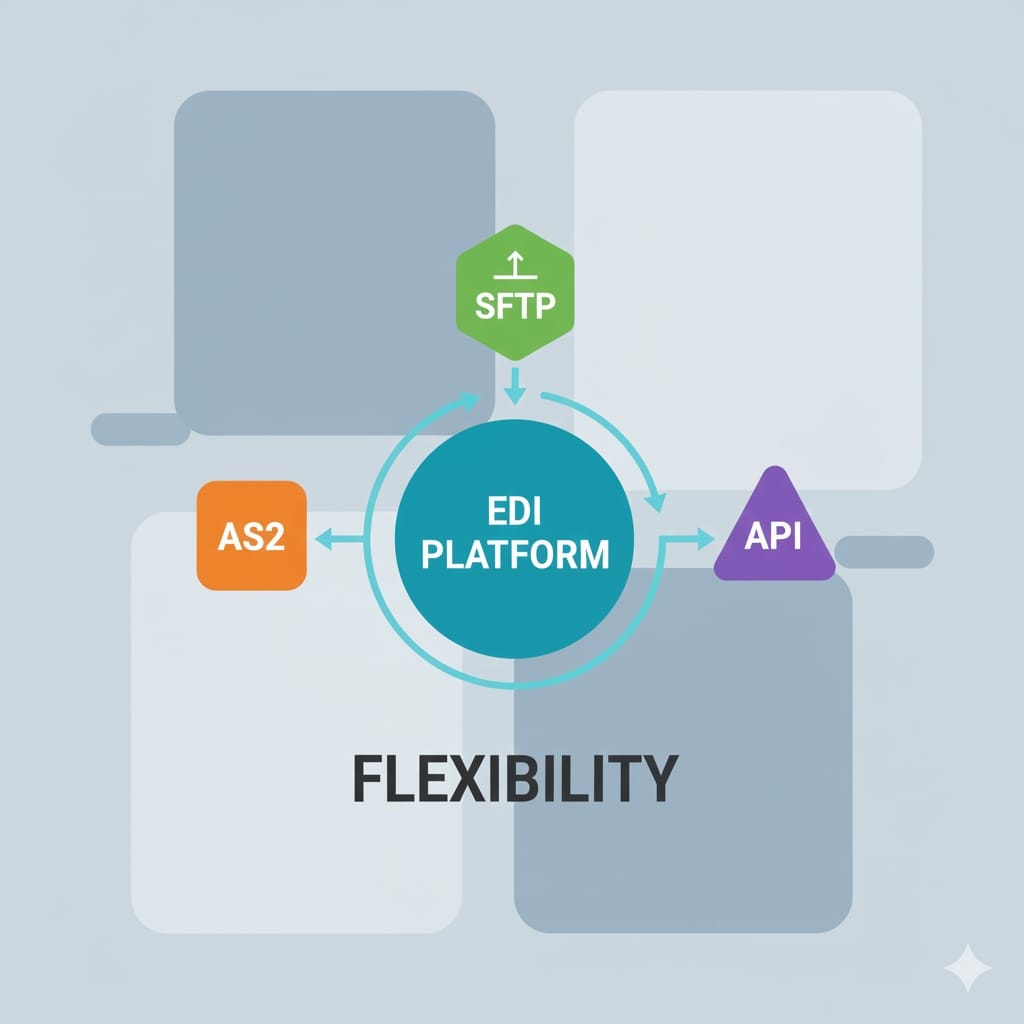
Document the communication method as well. Nexus VAN supports AS2, SFTP and REST API and has interconnects to VANs globally. AS2 and SFTP are ways to exchange business files; a REST API is a software connection for exchanging data. Knowing what each partner currently uses helps the coordinator identify which connections need setup or partner coordination rather than assuming every route changes in the same way.
Test the document and its acknowledgment
Use the trading partner's published EDI implementation guide to confirm its required document version, testing process and acknowledgment expectations. For a purchase order, trace the route from the sending system through the VAN to the receiving side and confirm the response expected by that partner. Repeat the exercise for the other document types that matter to the business.
An acknowledgment is a response indicating what happened to a transmitted document. In an ANSI X12 workflow, a 997 functional acknowledgment can say whether a document passed the receiver's syntax check or was rejected. It does not establish that the order or its business content was accepted. Make that distinction explicit in your cutover criteria so a successful syntax response is not mistaken for complete business validation.
Reconcile both providers before sign-off
During a migration, Nexus VAN uses dual-VAN reconciliation: the old VAN and the new VAN run side by side while documents are accounted for before the old route is retired. Compare the records for each partner and document type, including transaction status, acknowledgments and control numbers, which are identifiers used to trace EDI exchanges. Its management portal provides visibility into those items for the new route.
The comparison must account for messages that are missing, rejected or sent more than once. Give each exception an owner and a disposition, then confirm that business users agree the route is ready. Do not treat matching document totals alone as sufficient: two routes can report the same total while containing different transactions. For a deeper cutover checklist, see our article on proof from both providers at sign-off.
Retire a legacy route only after the comparison is resolved. Dual-VAN reconciliation makes switching low risk by turning a cutover decision into a review of identifiable documents, acknowledgments and control numbers, rather than a guess based on whether traffic appears to be moving.
Turn the Findings Into a Better Acquisition Decision
The best diligence output is a short decision record that a CFO, CIO and EDI coordinator can all use. It should show the contractual exit date, the incumbent cost baseline, the remaining unknowns and the evidence needed before a new route takes over. Keep the technical inventory attached, rather than putting every partner detail into the executive summary.
- Make contract dates visible. Put notice deadlines and renewal terms in the acquisition work plan so the team can preserve its options.
- Compare like with like. Use actual document sizes and activity when assessing usage charges. Identify rounding, per-document minimums, per-partner charges and archive-access fees separately.
- Preserve access to history. Agree on what records the business needs before ending the incumbent service, including the format and cost of retrieval.
- Give the EDI coordinator a named counterpart. Contract review alone cannot identify every partner requirement, acknowledgment or low-volume route.
- Set evidence-based cutover criteria. Require testing, exception resolution and dual-VAN reconciliation before retiring each old route.
These practices give deal teams a practical answer to vendor lock-in. You can quantify what it costs to stay, understand the price of leaving and reduce transition risk without assuming that every partner will behave identically. The result is a decision you can defend in an investment review and execute with the people who operate the EDI network.
Frequently Asked Questions
What counts as an EDI vendor exit cost in acquisition diligence?
Include any contractual termination payment, remaining minimum commitment, archive export charge, transition assistance charge, partner testing work and the cost of running both providers during migration. Assess the recurring cost of keeping the inherited VAN separately.
Which EDI contract terms should a buyer review before closing?
Review renewal and notice terms, early termination provisions, minimum commitments, assignment and change-of-control language, data access rights and the scope and cost of transition assistance. Compare those terms with actual invoices and amendments.
Can an acquisition team calculate potential EDI savings from a rate card alone?
No. Compare actual usage, document-size rounding, minimum charges per document, partner charges and archive fees as well as the quoted rate. A stay-versus-switch model should include any incumbent exit cost and the cost of operating both VANs during migration.
How does dual-VAN reconciliation reduce switching risk?
It keeps the old and new VAN routes operating side by side while the team compares documents, acknowledgments and control numbers. Exceptions can be investigated before the old route is retired, making cutover a decision based on evidence rather than assumption.
What should an EDI coordinator collect for an acquired business?
Collect a list of active trading partners, document types, sending and receiving identifiers, communication methods, acknowledgment requirements, route owners and relevant partner implementation guides. Add the archive and export requirements needed before the old VAN contract ends.
Price the Exit, Then Plan the Switch
If an acquisition reveals an expensive legacy VAN, compare its full bill and exit obligations with exact kilo-character pricing. We can walk through how dual-VAN reconciliation supports a low risk move while you account for every document before retiring the old route.
Schedule Demo