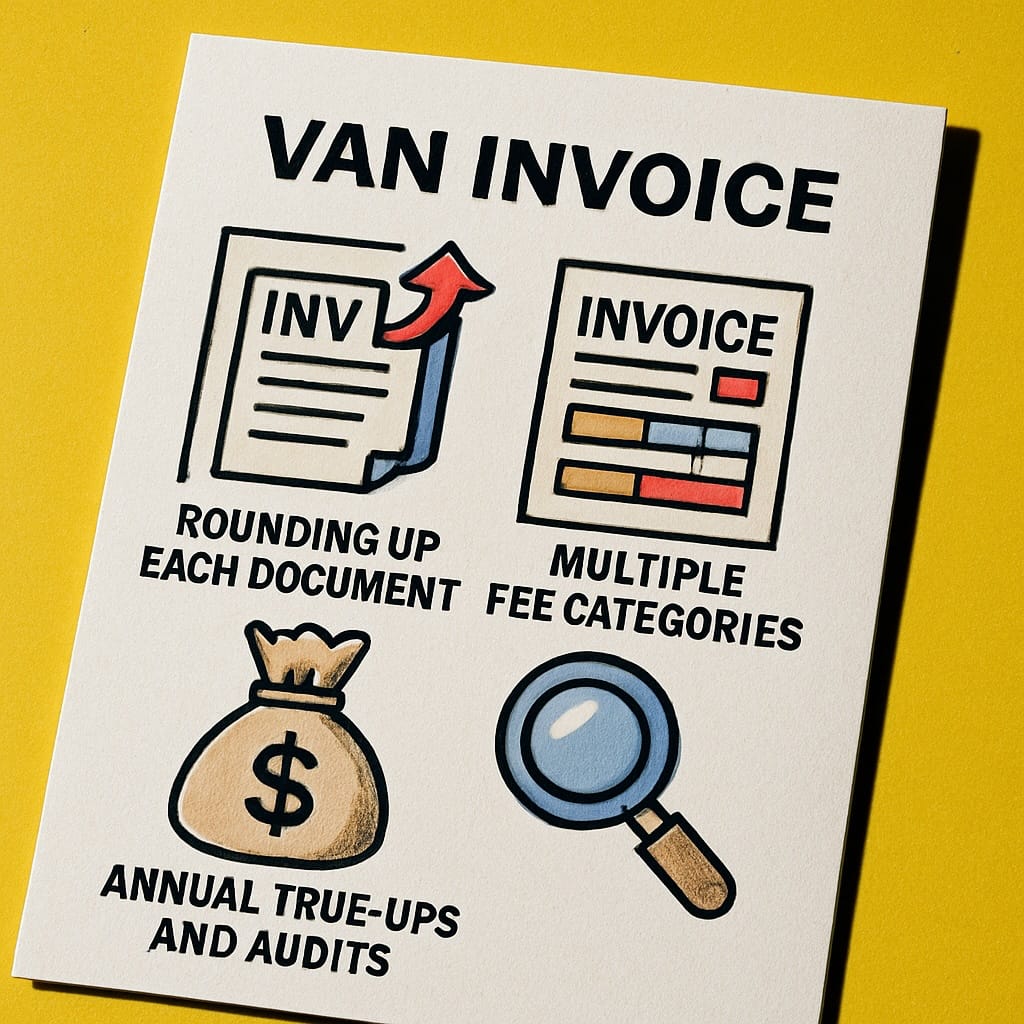

Kilo-character (KC) billing is redefining how finance, IT, and EDI leaders evaluate and control electronic data interchange (EDI) expenses. With transparent, character-based pricing, teams can finally verify that their EDI invoice aligns with their actual data usage—no hidden fees, inflated document counts, or unpredictable surcharges. When managed well, reconciling kilo-character usage against your EDI invoice becomes a straightforward accounting task. For organizations determined to end overbilling and regain cost control, understanding this process is essential. Nexus VAN leads the industry with transparent KC pricing, proven reliability, and customer-first support. This guide provides a clear framework for finance and technical teams to verify, defend, and optimize EDI billing each month.
A kilo-character represents 1,000 characters of EDI data transmitted over your VAN. KC billing provides a direct link between your monthly invoice and your actual data usage, unlike legacy VAN models that base charges on transactions, mailbox counts, or rounding schemes. Every character sent or received counts toward your usage, ensuring billing reflects true EDI activity rather than administrative overhead.
Nexus VAN’s approach is built on this philosophy: clients pay only for the real volume of data they transmit, with zero rounding or add-on fees. This model eliminates surprises, so finance teams can verify every invoice and confidently defend their budgets.
For IT managers, EDI coordinators, and finance leaders, reconciling a KC-based bill with actual usage is a repeatable process. Here’s how to perform a complete review:
If your provider does not supply raw KC calculations, request detailed counts and documentation of how usage was tallied for the billing period.
Compare your calculated charge to the invoice’s billed amount for KC usage. If differences appear, consider the following common causes:
Nexus VAN eliminates nearly all of these reconciliation headaches by strictly charging on exact KC usage—no rounding, no overage, and no mailbox or document fees.
One of the most persistent sources of billing error is document-level rounding, where each message is billed as a whole KC unit even if it contains only a fraction of that volume. Multiply this over hundreds or thousands of transactions, and your cost can be dramatically inflated.
Carefully check your vendor’s rounding logic, minimum charge rules, and every line of the invoice. Are there non-usage-based fees inflating your spend? With Nexus VAN’s transparent model, these erroneous and opaque costs are absent, which streamlines both budget reviews and vendor audits.
Not all increases in KC usage are billing errors. Reconcile spikes in your invoice by referencing:
If the usage aligns with known business events, the charge is likely legitimate. If the invoice increases with no correlating business justification, investigate further or request clarification from your provider.
If serious discrepancies remain after your review, escalate the issue and request explicit answers from your EDI VAN provider. Key questions include:
Full transparency is critical for financial control and audit readiness. Nexus VAN maintains this clarity as standard operating procedure, ensuring monthly reviews are simple and defensible.
Create and maintain a monthly spreadsheet with the following fields:
Over time, this worksheet becomes indispensable for tracking trends, fighting billing errors, and making the case for process or contract adjustments. If the vendor refuses to defend their logic or the same issue repeats for multiple cycles, it may be time to evaluate alternative VANs.
In a well-structured EDI environment, your invoice, usage logs, and contract should align precisely. Every line item should trace directly to business activity or approved service terms. Nexus VAN’s tiered KC pricing ensures each bill matches usage records without surprises, enabling finance, IT, and EDI teams to move away from detective work and toward strategic planning.
The result is a clean audit trail supporting compliance requirements, budgeting forecasts, and vendor management conversations.
Organizations that transition to Nexus VAN frequently cite newfound transparency and major cost reductions. For example, Spanx moved from a competitor with hidden fees and outdated rate structures, gaining control and clarity with Nexus VAN’s exact KC billing. TIGI, operating a complex retail supply chain, found that flexible pricing and the elimination of onboarding surcharges made reconciliation simple and predictable. These cases highlight how the right provider can turn EDI billing from a monthly headache to a routine check.
For reference on minimizing both cost and confusion at the contract stage, see our post A CFO’s Guide to Predictable EDI Budgeting.
For further reading on decoding VAN charge codes and common pitfalls, visit Common EDI VAN Fees Explained.
Address these issues with your provider and escalate within your organization if discrepancies are not resolved. Nexus VAN’s clean billing model reduces the need for repeated disputes and gives leadership confidence that EDI costs are always justified and auditable.
As the market shifts toward usage-based billing models, Nexus VAN stands out for its focus on clarity, predictability, and client empowerment. With KC pricing that aligns 1:1 with actual data transmission—no rounding, minimums, or ambiguous fees—teams can review their invoice, pull their portal logs, and immediately verify accuracy.
Additional benefits supporting reconciliation and peace of mind include:
To understand how predictable EDI spending unlocks operational efficiency, read our article Demystifying EDI VAN Pricing Models: What Determines Your Monthly Invoice and How to Optimize Costs.
A kilo-character (KC) equals 1,000 characters of EDI data transmitted. Billing by KC ties your costs directly to data volume rather than transaction or mailbox count, offering transparency and better budget control. Nexus VAN uses exact KC billing so teams pay only for what they actually send and receive.
Examine your contract and invoice. If every document is billed as at least 1 KC, or incremental overages appear despite low usage, document-level rounding could be inflating your cost. Nexus VAN bills on true totals without rounding up, eliminating this risk.
Check for unexpected charges beyond usage, such as mailbox fees, archive or support fees, onboarding or transaction surcharges. A usage-based model should minimize or eliminate these extras. Nexus VAN does not add these line items, simplifying monthly reviews.
Yes, if data volume changes due to new trading partners, more documents, or spikes in activity. Validate fluctuations by cross-referencing billing with actual business events. If usage is stable but the invoice jumps, review for rounding or new surcharges.
Request a detailed billing methodology from your provider and double-check your figures against raw log data. If discrepancies remain, escalate internally and, if needed, initiate a vendor review. Nexus VAN provides clear breakdowns and support for any invoice queries.
Yes. Nexus VAN specializes in risk-free migrations to straightforward, KC-based pricing, with dedicated onboarding assistance and tools for seamless cutover without business disruption.
Modern finance and IT teams do not need to accept confusing, padded, or opaque EDI invoices. With the right process and a trusted partner, reconciliation becomes a non-issue, freeing up time for work that drives the business forward. For more insight on maximizing EDI investments and selecting the right VAN for your needs, explore A CFO’s Guide to Predictable EDI Budgeting.
If you’re ready to simplify EDI costs and gain real control over your data spend, consider working with a transparent, experienced provider committed to fairness, reliability, and support. Nexus VAN exists to make this transition seamless and risk-free—helping you close the books each month with complete confidence.
