

A repeated EDI invoice may never become a second payable invoice, yet its retransmission can still appear on a VAN bill. That gap between business activity and network usage is where disputed charges begin. If your team cannot connect each charge to a specific transmission and its acknowledgment, you may be paying more than the work requires.
Quick Answer
Duplicate EDI messages create disputed VAN charges when a resend generates another billable transmission, even if the receiving business system processes only one document. Compare business references, control numbers, acknowledgments and billed usage before requesting a credit. Nexus VAN prices by the kilo-character and never rounds up document size, so you pay for the exact data transmitted. Dual-VAN reconciliation keeps a switch low risk.
In This Article
What counts as a duplicate, and why the distinction matters
Electronic data interchange, or EDI, is the structured exchange of business documents between organizations. A value-added network, or VAN, carries those documents between trading partners. A duplicate EDI message is an additional transmission that represents the same intended business transaction, rather than a genuinely new order, shipment or invoice.
That definition has an important qualification: identical business meaning does not require identical electronic files. A sender might transmit the same EDI 810 invoice again with a new electronic envelope and new control numbers. Conversely, two EDI 850 purchase orders from the same buyer may look similar but represent separate orders. The business reference, sender, receiver, transaction type and content must be considered together.
There are several ways a duplicate can arise. A sender may resend after an acknowledgment is delayed. An operator may upload a file while an automated retry is already in progress. A recovery procedure may replay documents that were previously delivered. Or two configured routes may both send the same business transaction. These are plausible investigation paths, not proof that any particular provider caused the repeat.
Start by separating three questions that often get collapsed into one: Did the sender transmit twice? Did the receiver process twice? Did the VAN bill for two transmissions? Different systems answer each question. A successful duplicate check in the receiver's business application may prevent a second order from posting while leaving two legitimate network transmissions to examine on the bill.
The cost issue: A second transmission can mean a second charge
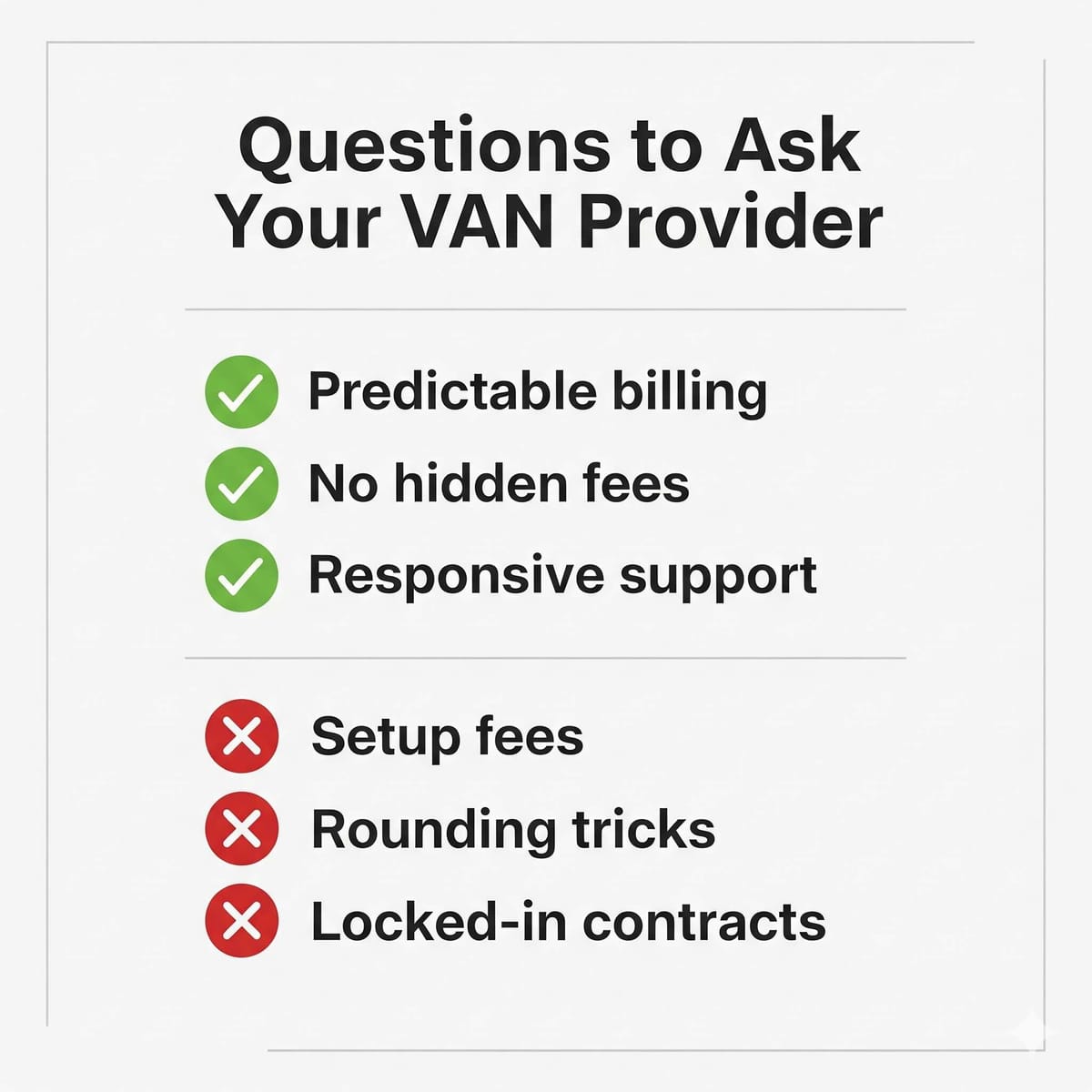
Many legacy VANs use billing rules that magnify the effect of a resend. Per-message charges or minimum charges per document can make each attempt a separate cost event. Rounding every document up in size can increase measured usage beyond the actual data exchanged. Per-partner fees and archive-access fees may add costs elsewhere on the same invoice, complicating the total when finance tries to explain a variance.
Consider a hypothetical supplier sending one EDI 856 advance ship notice. The sender does not see the expected acknowledgment and sends it again. The partner processes only one shipment notice. Under a per-message contract, the two transmissions may both be billable. Whether a credit is due depends on the agreement and on why the second transmission occurred. A duplicate business document does not automatically mean an incorrect VAN charge.
The useful question for finance is: What chargeable event does the contract define, and which records establish that it happened? A network may charge for transmission, not successful business acceptance. Ask the provider to identify each charged event and its billing rule. If a retry happened because of a provider-side issue, the incident record and contract terms may become relevant to a credit request. If your application deliberately sent both files, the charge may follow the contract even though the extra transmission was avoidable.
Nexus VAN prices by the kilo-character, and we never round up the size of your documents, so you are billed accurately for the exact data you transmit, and nothing more. A retransmitted document still contributes actual transmitted data. Exact-size billing does not make duplicate traffic free or replace the need to prevent it. It does remove document-size rounding as an additional source of disagreement when you reconcile usage.
For the budget owner: Do not compare the number of orders posted in your business system directly with the number of VAN charges. Reconcile transmissions first, then apply the billing rules in your contract. That is how you distinguish an unnecessary resend from an improperly calculated charge.
The evidence that separates a repeat from a new transaction
An EDI coordinator needs more than a matching invoice number to establish a duplicate. Assemble a record that identifies both the business document and each transmission attempt. Keep copies of the transmitted files if your retention policy permits it. Preserve the acknowledgments and any operational notes explaining why someone initiated a resend.
| Evidence | Question it helps answer | Important limitation |
|---|---|---|
| Business reference, such as an order or invoice number | Do the files describe the same intended transaction? | A reference alone may be reused, corrected or interpreted differently by partners. |
| Sender and receiver IDs, document type and version | Are you comparing the same trading relationship and workflow? | Partner-specific rules should be checked against that partner's published EDI implementation guide. |
| Interchange, group and transaction control numbers | Was the electronic envelope repeated or regenerated? | New numbers do not prove a new business transaction. |
| Transmission time and route | Which attempt preceded a resend, recovery action or route change? | A timestamp alone does not establish receipt or business acceptance. |
| Functional acknowledgment and application outcome | Did syntax pass, and did the business system act on the document? | These are different stages with different evidence. |
| VAN usage detail and contract terms | Which transmissions were billed, and under what rule? | A duplicate may still be billable if the contract charges for each transmission. |
A control number is an identifier used to track an EDI interchange, group or transaction set. It is especially useful when you are tracing a transmission through systems, but it is not a universal duplicate key. If the sender regenerates an invoice, its business reference may stay the same while its control numbers change. If an existing file is resent unchanged, the identifiers may repeat. Look at both patterns before deciding which document represents the original attempt.
An acknowledgment is a response about a stage of delivery or processing. For X12 traffic, a 997 functional acknowledgment reports whether the receiver's syntax check accepted or rejected the document. It does not prove the order or its contents were accepted by the receiving business system. Transport receipts and business responses also serve different purposes; confirm what your partner expects in its published EDI implementation guide. The guide to EDI 997 and 824 acknowledgments explores how to use those responses in exception review.
A practical way to reconcile a disputed VAN bill
When a charge looks wrong, keep the investigation narrow at first. Choose one business reference and trace it from creation through delivery, acknowledgment and billing. If you can explain one disputed pair of transmissions completely, you have a repeatable approach for the rest of the invoice.
1. Define the suspected duplicate
Record the sender, receiver, document type and business reference. Note whether your concern is an identical file sent twice, a regenerated file with the same business meaning or two different documents that your business application treated as duplicates. This prevents the investigation from starting with the assumption that every repeated reference is an error.
2. Build a sequence of transmission attempts
List each attempt in order. For each one, record the route, available control numbers, time sent and any acknowledgment. Ask who initiated the resend and why. If one attempt used a partner-direct connection and another used a VAN interconnect, keep the routes distinct. Otherwise, your team may attribute the same event to the wrong bill or overlook a second path.
3. Check what the receiver actually did
Compare syntax acknowledgments with the receiving application's outcome where that information is available. A rejected syntax check, a received file and a posted invoice are different findings. If the partner controls the receiving application, request the relevant status from that partner instead of inferring it from a 997. For partner-specific acceptance rules, consult its published EDI implementation guide.
4. Map charged events to actual usage
Match the provider's itemized usage to your transmission sequence. Note any duplicate charge lines, minimum document charges, rounded size units or charges assigned to an unexpected partner. Ask which data was measured, whether a resend was counted separately and what contract provision supports the amount. Our kilo-character invoice reconciliation guide provides a related framework for reviewing measured usage.
5. Submit a focused dispute and keep the decision
Give the VAN the original transmission identifier, the suspected repeat, relevant acknowledgments, the invoice line and the specific billing question. Ask for a correction only when the records and contract support it. Retain the response, including the provider's explanation if the charge stands. That history helps finance spot recurring contract problems instead of reopening the same question every month.
If the disputed amount is small but the investigation is lengthy, calculate the internal effort as well as the billed usage. Repeated manual reconstruction is a cost in its own right. For a CFO or private equity director reviewing several businesses, consistent evidence fields make it easier to compare network spend without assuming that every operation counts a message the same way.
Best practices that reduce repeats and make charges easier to verify
You cannot resolve every ambiguous delivery event by simply sending the document again. A safer process makes retry decisions explicit and preserves the reason for each additional attempt. Design the procedure with the trading partner's published implementation guide in mind, because acknowledgment timing and document handling vary by partner and version.
- Check status before a manual resend. Look for the earlier attempt and its acknowledgments. If status remains unclear, document the uncertainty instead of assuming the partner never received it.
- Assign one owner for retry decisions. When automated retries and manual operators act independently, both can send another copy. Make it clear who is allowed to initiate a resend and how that action is recorded.
- Use business references alongside control numbers. Control numbers trace the electronic message. Business references help determine whether two messages represent one order, shipment or invoice.
- Separate duplicate detection from delivery confirmation. A receiving application can reject a second posting without proving that the network sent only once. Maintain evidence for both outcomes.
- Review recurring billing patterns. If the same partner or document type repeatedly generates extra transmissions, investigate the operational cause before treating every invoice line as a standalone dispute.
- Retain enough history to explain a charge. Align transmission records, acknowledgment records and billing statements under your organization's retention policy. Do not wait for a monthly invoice to reconstruct an incident from memory.
Use a management portal as an evidence source, not as a substitute for business controls. Our portal shows transaction status, acknowledgments and control numbers. Those fields help your EDI coordinator locate the relevant attempts and give finance a clearer account of what happened. The underlying decision about whether a charge is due still comes from measured usage and the contract.
There is also a contract decision to make. Spanx's published case study describes leaving a legacy VAN with hidden fees, high per-message rates, per-partner charges and archive-access fees in favor of predictable, transparent pricing. That example does not establish that any particular resend will be credited. It shows why evaluating the full billing structure matters alongside fixing duplicate-message workflows.
Switching VANs can be low risk when you reconcile both routes
An unclear billing model may make switching attractive, but the migration itself raises a reasonable concern: Could an order be missed, sent twice or acknowledged on the wrong route? The answer is to compare old and new paths before retiring the old one, rather than relying on a cutover date alone.
During a migration, Nexus VAN uses dual-VAN reconciliation: the old VAN and the new route run side by side so documents can be accounted for before the old route is retired. For the EDI coordinator, that means keeping a partner and document inventory, comparing control numbers and acknowledgments, identifying exceptions and resolving them before closing a route. Side-by-side operation requires care to avoid sending the same production business document twice. Define which route is authoritative for each flow and compare the records accordingly.
Start with a list of partner IDs, document types, current routes and required connection methods. Check each partner's published EDI implementation guide for version-dependent requirements. Where applicable, Nexus VAN supports AS2, SFTP and REST API and interconnects to VANs globally. Test representative traffic and acknowledgment handling for each intended path. Then use reconciliation evidence to decide when the old route can be retired. For a closer look at the process, see our dual-VAN reconciliation guide.
The financial comparison should happen alongside that technical work. Review the old contract's per-message minimums, document-size rounding, partner charges and archive-access fees, then compare those rules with exact-size kilo-character pricing. A lower unit rate alone is not the whole answer if unnecessary resends continue. The strongest plan reduces avoidable traffic, establishes an auditable bill and checks every migrating document before changing routes.
Decision rule: Treat repeat transmissions as an operations issue and unclear charge calculations as a contract issue. Resolve both. A low-risk migration accounts for documents across the old and new routes before the old route is retired.
Frequently Asked Questions
Can a VAN charge for a duplicate EDI message?
Yes, if the contract bills each transmission or measures the data sent. A duplicate business transaction may still create a separate transmission. Check the contract, the usage record and the reason for the resend before disputing the charge.
How can I tell whether two EDI files are duplicates?
Compare sender and receiver IDs, document type, business references, content, control numbers, timestamps and acknowledgments. Matching control numbers can help, but a regenerated duplicate may have new control numbers. Check the partner's published EDI implementation guide for requirements specific to that flow.
Does an EDI 997 acknowledgment mean an order was accepted?
No. A 997 functional acknowledgment reports whether a document passed the receiver's syntax check and can report acceptance or rejection at that level. It does not establish that the order or its content was accepted by the receiving business system.
Will exact-size billing remove charges for retransmissions?
No. A retransmission adds data transmitted and can add billable usage. Exact-size kilo-character billing removes document-size rounding from the calculation, but your team still needs to investigate and prevent avoidable resends.
How does dual-VAN reconciliation reduce switching risk?
The old VAN and new route run side by side during migration so the team can compare documents, control numbers, transaction status and acknowledgments. Exceptions can be investigated before the old route is retired, reducing the chance that a missed or repeated document goes unexplained.
Make the next billing review a decision point
A disputed duplicate is an opportunity to identify both an unnecessary resend and a pricing rule that may be inflating your bill. Trace the business document, account for each transmission, apply the contract and fix the retry process. If repeated disputes expose a costly legacy pricing structure, compare what you actually send against exact-size billing and plan a low-risk move with both routes reconciled before retirement.
Review repeat traffic and the cost of your current VAN
Bring your disputed charge examples and current billing rules. We can discuss how Nexus VAN's exact-size kilo-character pricing and dual-VAN reconciliation fit your cost review and migration plan.
Schedule Demo