
What Is EDI as a Service (EDIaaS)? A CTO’s Buyer Guide for 2026

December 16, 2025
Tired of EDI mailbox fees and clunky systems? Unpack EDI as a Service (EDIaaS) to achieve predictable costs, auditability, and simple integration with major ERPs.
Header image

As leaders tasked with digital transformation and operational stability, CTOs, CIOs, and IT heads face mounting pressure to modernize their organization’s EDI infrastructure before the next contract cycle. By 2026, Electronic Data Interchange as a Service (EDIaaS) stands at the center of cost-efficient, risk-reduced B2B automation, but what does this actually mean for your team and your bottom line, and how do you vet a solution to ensure control and transparency?

Understanding EDIaaS: Where It Fits and Why It Matters

Let’s begin by clarifying the terms. EDI (Electronic Data Interchange) streamlines business document exchange—orders, invoices, advance ship notices—by letting systems "talk" in standardized languages like X12 or EDIFACT. Traditionally, companies relied on Value Added Networks (VANs) to route EDI messages securely. Many of us remember tangled contracts, mailbox fees, and mysterious surcharges. EDIaaS takes those core VAN functions and delivers them as a managed, cloud-based service, eliminating the burdens of on-prem hardware and specialist staffing while giving you scale and visibility when you need it most.

A stressed man looks at stock market data on his computer screen in an office setting.

Key EDIaaS Capabilities at a Glance:

  • Provider hosts and scales the EDI infrastructure (no more server rooms)
  • Connectivity with all trading partners globally, supporting mainstream protocols (AS2, SFTP, REST API)
  • Robust document translation (covering formats like X12, EDIFACT, HL7, and even XML, flat files, and Excel)
  • Transparent, usage-based (often kilo-character) billing with clear SLAs
  • Compliance and audit controls for modern security needs (e.g., SOC 2)

Why IT Leaders Are Moving to EDIaaS in 2026

For established organizations, modern EDIaaS platforms such as the Nexus VAN deliver measurable and immediate impact.

1. Substantial Cost Reduction

  • No hardware, software, or infrastructure to maintain
  • Eliminates fragmented VAN contracts, mailbox, and per-message fees
  • Pay only for actual data transmitted; no rounding up or "breakage"

Customers report savings of 40-80 percent compared to legacy models. For a realistic breakdown on how hidden costs sneak into traditional EDI bills, see this guide on EDI VAN billing.

2. Simplicity and Talent Optimization

  • Removes need for in-house EDI specialists and offloads "keep the lights on" work
  • Your team can now focus on business process automation, integration, and analytics
  • Managed support means your time is spent on growing your business, not troubleshooting EDI pipelines
Two professionals analyzing stock market data and graphs at a desk.

3. High Reliability, Uptime, and Auditability

  • Enterprise-grade hosted uptime (Nexus VAN maintains 99.998% uptime)
  • Continuous monitoring, full audit trails, and SOC 2 certified environments
  • Resiliency for global operations, from multi-region deployments to automated failover

How EDIaaS Works: Architecture and Integration

Understanding the typical EDIaaS stack helps CTOs assess vendor maturity and fit.

Core Layers:

  • Connectivity: Global interconnects to all major VANs, supporting key B2B data standards
  • Translation: Real-time mapping of internal formats (SAP IDoc, Oracle XML, Excel, CSV, flat file) to EDI standards
  • Routing and Orchestration: Contextual document flows, customizable by partner or business rule
  • Portal and UI: Dashboards for monitoring, trading partner setup, activity alerts, and visibility into every transaction
  • Security: Role-based access control, encryption (in transit and at rest), and compliance tooling

Modern solutions like Nexus VAN include comprehensive API integrations with leading ERP systems (such as Oracle, SAP, and Infor), and a fulfillment portal to automate label generation, packing slips, and shipping paperwork.

For a hands-on walkthrough, consider requesting a demo to see how a contemporary interface can simplify your EDI management.

Transparent Pricing in EDIaaS: Ending the Hidden Fee Headache

Pricing models have long caused confusion and frustration among EDI users. Legacy contracts often buried costs in mailbox fees, document minimums, set-up surcharges, and overage penalties. These not only complicate budgeting but can inflate annual bills significantly.

Granular Measurement: Kilo-Character (KC) Billing

  • Exact kilobyte character count of your transmitted documents, with no rounding
  • No mystery over what you are billed for each cycle
  • As your business grows, tiered plans provide further discounts at higher volumes

For a deeper dive into why rounding and per-transaction fees drive up costs, our breakdown on overage fees in EDI VANs covers the subject transparently.
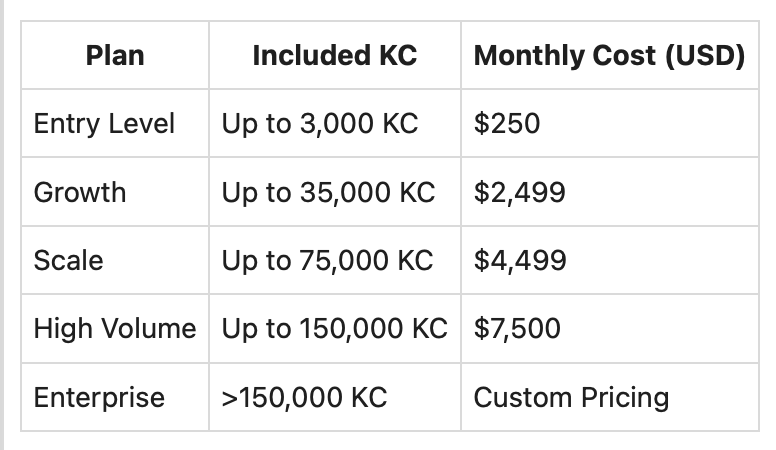
All plans come with free migration support, unlimited IDs, and no mailbox or transaction fees. If you want more advice on how to optimize EDI budgets without surprises, visit A CFO’s Guide to Predictable EDI Budgeting.

Migrating to EDIaaS: De-Risking the Switch

We know from years of experience that most professionals pause at the thought of moving mission-critical EDI operations. Migration can feel risky because it touches your revenue-critical flows and involves external partners with strict testing requirements.

Two business professionals reviewing data on a tablet, fostering collaboration and teamwork in a modern office setting.

Building a Low-Risk Migration Plan

  • Use a dedicated migration dashboard for live cutover status on every trading partner
  • Run new and old systems in parallel so no transactions are dropped
  • Take advantage of free migration and a 90-day trial to validate performance
  • Leverage a VAN already interconnected worldwide, so no trading partner is left behind
  • Coordinate directly with experienced EDI specialists for end-to-end support

Our migration process has been developed to minimize disruption, drawing on direct experience helping numerous recognizable brands. For more on the real cost and risk of EDI downtime, see this analysis of EDI service interruptions.

Core Questions for Evaluating EDIaaS Vendors

To make an informed decision, every CTO and IT lead should consider these fundamental questions:

  • What measured uptime and support SLAs are documented?
  • How easy is it to connect to every global trading partner?
  • Does the solution support your preferred standards and protocols (AS2, SFTP, X12, EDIFACT, XML, CSV)?
  • Is billing precise, granular, and free from overage or mailbox fees?
  • How transparent is migration progress, and do you have full testing visibility?
  • Is there a risk-free trial to validate the platform before a long-term commitment?

For more on what differentiates world-class EDI support and service, check out how to evaluate EDI support.

Building a Business Case: The 2026 EDIaaS Payback

Illustrating the return on investment is straightforward if you know the real numbers:

  • Gather all current VAN and EDI fees, including license, hardware, mailbox, and per-message charges
  • Estimate internal FTE/time required to maintain legacy arrangements
  • Use actual document volumes to model exact KC pricing—no more hidden costs or estimations

Typical clients moving to a platform like Nexus VAN see their total EDI spend shrink by 40-80 percent. That means better predictability for CFOs, increased ability to scale, and much less time lost to operational firefighting. Transparency, reliability, and migration support combine for a business case rooted in both bottom-line improvement and top-line risk reduction.

Getting Started: Your Next 90 Days

  1. Inventory all trading partners, document types, and current protocols
  2. Review 12 months of invoices to understand current fee structure
  3. Estimate total annual kilo-character (KC) usage
  4. Shortlist providers with true usage-based (KC) transparent pricing and risk-free pilots
  5. Engage in a 90-day parallel pilot, using a migration dashboard for live cutover insights
  6. Finalize phased migration and only decommission your legacy system after a stable transition

EDIaaS in 2026: Risk-Free, Predictable, and Built for the Real World

Modern EDIaaS is mature, reliable, and, with the right partner, takes away the fear of switching. Nexus VAN was created by and for professionals who have seen the worst side of "black box" EDI contracts. Every feature, from our guaranteed migration to precise KC billing and no hidden fees, is designed to put cost, control, and confidence back in your hands.

If you're ready to benchmark your spend, model KC-based pricing, or design a detailed migration plan, reach out to us for a no-pressure chat. See why more industry leaders are ending their VAN pain for good.

Share this post