
Partner Billing Charges Explained for EDI Users

December 9, 2025
Puzzled by EDI "Partner Billing" charges? We break down these secret VAN network tolls. Find out how they're calculated, why they are optional, and how to switch to a transparent provider with all interconnects included.
Header image

Few things frustrate finance and IT leaders more than puzzling line items on your EDI VAN invoice. "Partner billing" charges are among the most persistent offenders, often swelling monthly costs and leaving even the most seasoned CFOs and EDI coordinators scratching their heads. As a team that's worked with countless professionals migrating away from these confusing fee structures, we're uniquely equipped to break down precisely what a partner billing charge is, how it ends up on your statement, and (critically) whether you genuinely owe it to your VAN provider. Let’s get clear about what’s happening behind the scenes, so you can take control of your EDI budget with confidence.

Cutout paper composition of male with magnifier received expensive taxes and payments on blue background

Understanding the ‘Partner Billing’ Charge

Within the world of EDI (Electronic Data Interchange), a partner billing charge refers to an extra fee your VAN may tack on when you exchange data with trading partners connected through different VANs. (Think of it as an old-school "network toll" for traveling outside your provider’s direct environment.) This usually applies whether you’re sending or receiving EDI documents routed through international or external networks, which is quite typical in complex supply chain relationships.

  • What does this look like in practice? You’ll see line items such as “Partner Billing,” “Interconnect Fee,” or “External VAN Charge” on your monthly invoice.
  • How do providers justify these charges? Historically, legacy VANs claimed the costs covered cross-network integration, interconnect agreements, and reliability. Yet, in our experience, global EDI interconnects have become automated and universal, so the true incremental cost today is negligible.

How Are Partner Billing Charges Calculated?

There is no universal industry formula, which means each provider structures these charges differently. Here is what you might see:

  • Kilo-character (KC) based: The most common metric, charging you per thousand characters of EDI data exchanged with external partners.
  • Per-document or per-envelope: Less common but possible, charging you for every file or message routed via interconnect.

Fees are typically aggregated monthly and often get bundled with regular traffic charges, making them hard to spot unless you scrutinize your bill closely.

Do You Actually Owe It? The Truth About Partner Billing Charges

This is the critical question, and the answer is: Not necessarily. There is no EDI industry rule or compliance mandate requiring providers to levy partner billing or interconnect surcharges. It’s entirely up to your contract, and more a choice than a technological requirement in this modern era of seamless network compatibility.

  • If you’re seeing these fees, it’s not because they’re unavoidable, but because your provider has chosen to itemize and charge them. Many of our customers, prior to migrating, had paid tens of thousands annually in such fees without realizing they were entirely optional in today’s EDI climate.
  • At Nexus VAN, our structure is clear: all global VAN interconnect costs are included in your usage fee. No partner billing, mailbox, or surprise upcharges ever. Billing transparency is core to our mission.

Why Do Legacy VANs Still Add These Charges?

In our work guiding EDI migrations and optimizing costs, we find that partner billing fees are largely a legacy profit center. The infrastructure excuses are outdated—today’s EDI interconnects function seamlessly, yet the cost burden remains. For many organizations, this can add up to more than 50% of your EDI spend—an entirely avoidable penalty, especially when modern VANs like ours have proven you do not need to budget for these at all.

Person's hand holding a company invoice on a clipboard with a pen.

How to Spot and Evaluate Partner Billing Fees on Your Invoice

Even if you believe you haven’t been billed for interconnect services, it’s well worth checking. Here’s how:

  1. Locate the line items: Scan your most recent VAN bill for any mention of “Partner Billing,” “Interconnect Fee,” or “External VAN Charge.”
  2. Understand the calculation: Request an itemized breakdown from your provider. Is the fee calculated by kilo-character, per-message, or mailbox?
  3. Benchmark against your contract: Review your service agreement and see whether partner billing was disclosed (hidden or otherwise).
  4. Compare and validate: If you’re curious how your statement would look without such charges, Nexus VAN will give you a side-by-side comparison using our clear, tiered KC pricing structure.

For more insights on dissecting EDI invoices, you might find our in-depth guide, Common EDI VAN Fees Explained: What’s Legitimate, What’s Not, and How to Read Your Bill Like a Pro, a practical walkthrough.
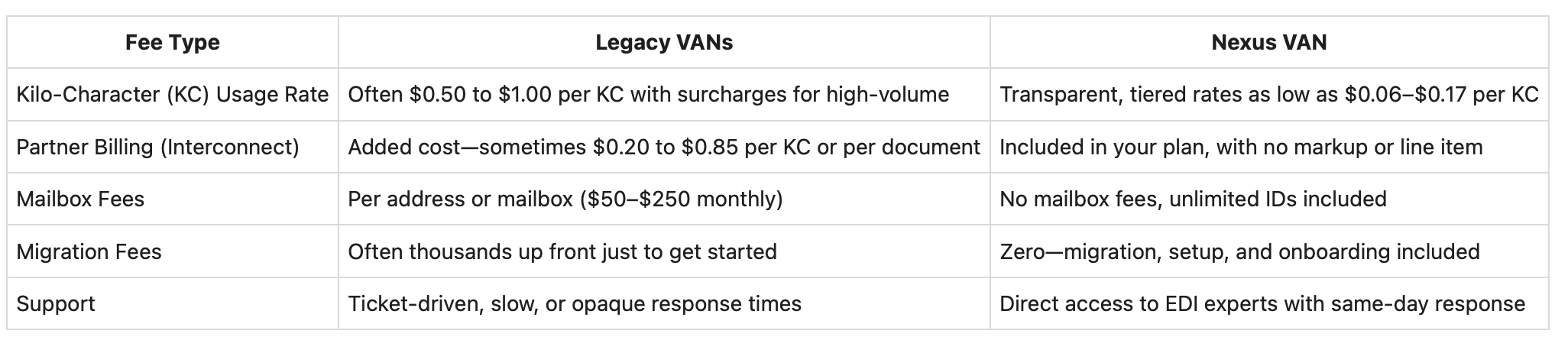
Traditional Fees vs. Real Transparency

Why Transparency in EDI Billing Matters for Your Business

When finance and technology leaders are forced to forecast based on unclear bills, budget unpredictability and risk go way up. These unwanted surprises are a direct cost to your business, not just in cash out the door but in time wasted on reconciliation, disputes, and audits. That's why we're passionate about eliminating hidden partner billing and all similar upcharges. You deserve a system that supports intelligent budgeting and total visibility, not one that leaves you reacting to unpleasant surprises.

If you want to learn more about predicting EDI costs, A CFO’s Guide to Predictable EDI Budgeting can help you build a smarter EDI cost model.

A Quick Glossary for EDI Partner Billing

  • Partner Billing Charge: Added fee for exchanging EDI documents with trading partners outside your primary VAN network commonly charged by kilo-character, message, or mailbox.
  • Kilo-Character (KC): 1,000 characters of transmitted EDI data. The EDI usage billing standard.
  • Mailbox Fee: Monthly charge per EDI address or mailbox. (Not applicable at Nexus VAN where unlimited IDs are included.)
  • Migration Charge: Fee to switch or onboard to a new VAN, often hidden or omitted. At Nexus VAN, migration is free and risk-free.
  • Interconnect: The infrastructure and protocols linking disparate EDI VANs globally so data can flow between any combination of trading partners.

What To Do If You're Paying Partner Billing Charges

If your EDI VAN still charges for interconnects or partner traffic, now is a great time to step back and question it. Here’s a practical checklist for professionals considering next steps:

  • Review your most recent invoice for any interconnect, partner, or external VAN related charges.
  • Contact your VAN provider and ask how and why these costs are calculated. Are they negotiable? Are they truly necessary?
  • Request a fully itemized copy of your contract and historic statements for due diligence.
  • Compare with transparent models, like Nexus VAN, where all interconnects are included, and ask for a sample savings analysis.
  • Model your cost reduction by seeing how eliminating these fees impacts your budget over the next year.

Key Takeaways and the Path Forward

At Nexus VAN, we believe the era of unexplained EDI fees, especially partner billing, should be over. Your EDI costs should be predictable, logical, and easily auditable. By questioning outdated fee structures and embracing transparent models, you can regain control of your operational budget and free your team from administrative headaches.

If you’re ready to see what a transparent, risk-free EDI migration looks like, schedule a quick demo or send us a sample invoice. We’re happy to show how much you could save while gaining best-in-class support and technology. Your bottom line (and your team) will thank you.

Share this post