
When you manage EDI across dozens — or hundreds — of trading partners, small configuration errors don’t stay small. An incorrect ISA qualifier can trigger immediate rejections, stall purchase orders, delay ASNs, and create unnecessary churn across your supply chain.
ISA qualifiers aren’t complicated. But at scale, precision matters.
In every X12 transmission, ISA05 and ISA07 tell your trading partner what type of identifier follows — DUNS, GS1, or a mutually defined ID. If the qualifier and the actual ID don’t match, the file is rejected before it ever reaches business processing.
At low volume, that’s annoying. At high volume, it’s operational risk.
When you’re transmitting thousands of documents daily, even a short-lived qualifier mismatch can create a backlog that ripples through fulfillment, billing, and revenue recognition.
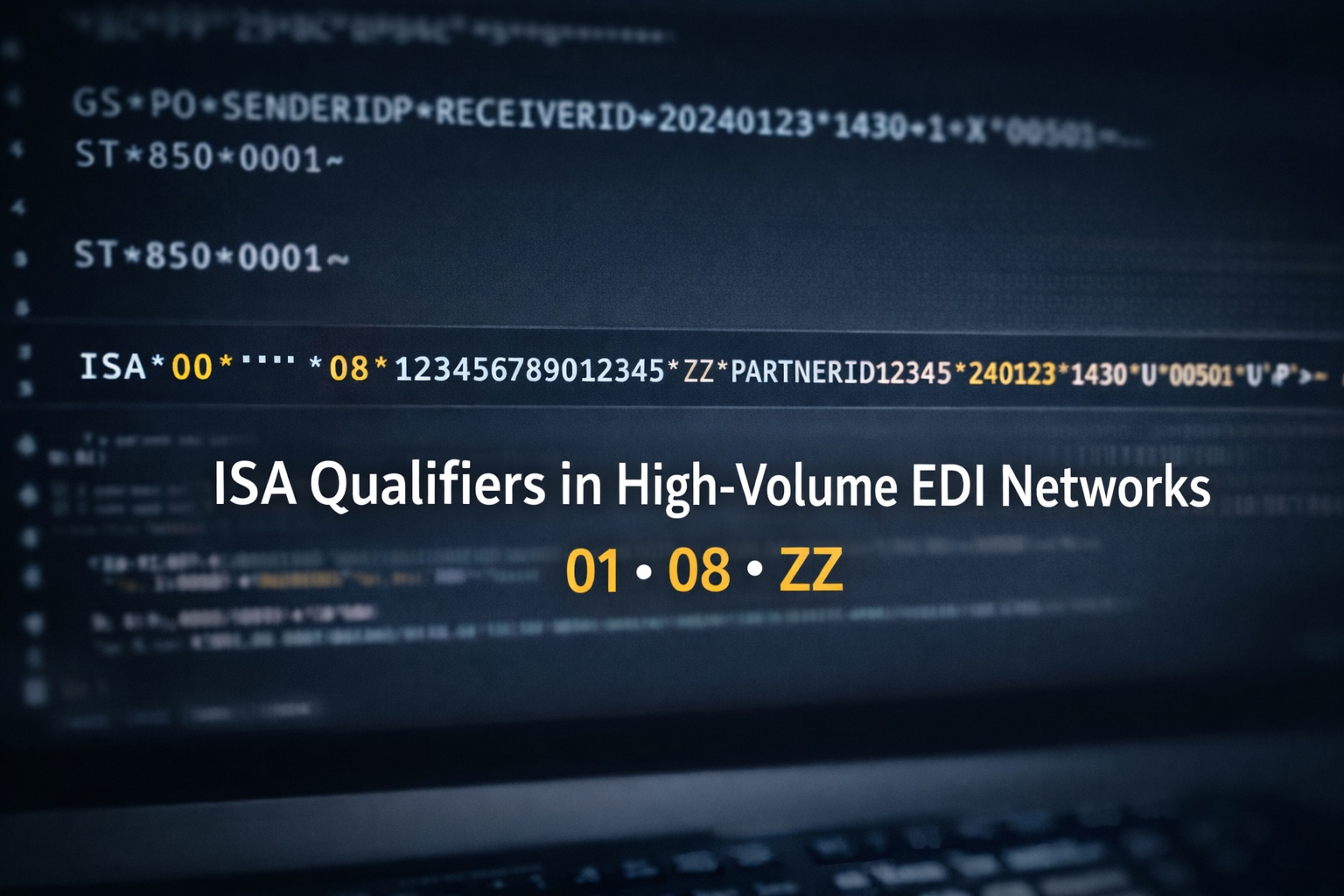
01 — DUNS Number: Used when partners require a 9-digit Dun & Bradstreet identifier. Common in automotive and global supply chains.
08 — UCC/GS1 ID: Legacy but still required by certain large retailers and logistics networks.
ZZ — Mutually Defined: Used for custom identifiers, internal mailbox IDs, tax IDs, or partner-defined formats. Widely used across retail and enterprise networks.
At scale, you will almost always be managing multiple qualifier types simultaneously.
The error isn’t usually ignorance. It’s drift.
One qualifier mismatch in a high-volume partner connection can reject entire batches.
And if you’re working with a provider that rounds document sizes or charges per mailbox, those rejected retransmissions inflate costs unnecessarily.
If you manage EDI at enterprise scale:
At scale, automation is not optional.
Nexus VAN approaches this differently:
Because Nexus bills by exact data volume, rejected files don’t quietly multiply hidden fees. You maintain operational clarity and cost transparency even during troubleshooting.
ISA qualifiers are small fields with large consequences. When you manage 50+ trading partners, qualifier precision becomes part of operational stability — not just technical correctness.
With centralized management, automated validation, and exact usage billing, Nexus VAN gives enterprise teams the control they need without introducing unnecessary cost or migration risk.
If you’re modernizing your EDI infrastructure or consolidating multiple partner connections, Nexus VAN provides a scalable path forward — with full transparency into both operations and billing. You can explore the portal, review pricing transparency, or schedule a demo to learn more.
The ISA qualifier identifies the type of ID used in the sender and receiver fields of the EDI envelope. It tells your trading partner how to interpret the ID that follows (for example, DUNS, GS1, or a mutually defined value). If the qualifier does not match the ID format your partner expects, the transaction will typically be rejected immediately.
Your trading partner’s EDI implementation guide will specify the required ISA qualifier and ID format. If documentation is unclear, confirm directly with their EDI team before sending live traffic. With Nexus VAN, partner requirements are documented during onboarding and validated during testing to prevent envelope-level rejections.
Only if every partner explicitly allows it. Many organizations prefer ZZ for flexibility, but others—particularly automotive, retail, or international networks—may require 01 or 08. Nexus VAN allows you to manage qualifier mappings individually per partner while maintaining centralized visibility across your entire network.
If the qualifier is wrong, your document will likely be rejected with a 997 or 999 acknowledgment. That means the transaction was not processed at all. You’ll need to correct the envelope configuration and resend the document. Real-time monitoring in the Nexus VAN portal makes these envelope-level errors visible immediately, so you can correct them before they impact operations.
During migration, every trading partner’s envelope configuration—including ISA qualifiers—is validated before go-live. Nexus VAN manages ISA remapping and testing in phases to ensure no disruption to your trading relationships. Because billing is based strictly on actual kilo-character usage—not mailboxes or partner counts—you can migrate without introducing unexpected cost variables.
Yes. Pre-transmission validation and envelope checks help prevent incorrect ISA qualifiers from being sent in the first place. Nexus VAN includes automated compliance checks and dashboard-level visibility so your team can catch configuration errors before they result in rejected transactions.
As your trading partner network expands, small envelope inconsistencies multiply quickly. One incorrect qualifier across 40 or 50 partners can create cascading rejections. Centralized mapping management, validation, and transparent reporting become essential to maintaining stability as you scale.
