

If you manage EDI for a business that operates in both the US and international markets, choosing the right value-added network (VAN) becomes significantly more complex. Moving from a US-focused EDI footprint to a global operation changes your risk profile, compliance requirements, cost structure, and the way you onboard and support trading partners.
Here’s what to check to make sure your EDI VAN can support worldwide interconnects without introducing cost surprises or operational risk.
EDI may seem straightforward within a single country, but every region brings unique infrastructure and expectations.
When you work with multiple trading partners across various regions, the connection between your VAN and other VANs—or to alternative endpoints like AS2 or SFTP—is what keeps documents flowing smoothly. These connections (called interconnects) vary in complexity depending on where your partners and customers are located.
If your EDI provider lacks robust, established interconnects to the main European VANs, partners may not be able to recognize or process your data as efficiently as you expect.
Most US-centric EDI programs start here, later needing expanded interconnects as business grows overseas.
Without a VAN partner that consistently monitors and adapts to changing compliance rules, you may find yourself facing local market barriers or disruptions.
Global EDI introduces more partners, more document types, more regulations, and more opportunities for hidden costs or failures. What works domestically often does not scale internationally without deliberate planning.
Your first step is to list every trading partner and their region. Identify what VAN or connection each one uses, along with preferred protocols or formats. It’s best to ask prospective providers to confirm their interconnect coverage for each target country, and clarify onboarding timelines for new partners or regions.
Nexus VAN maintains interconnects to every major VAN worldwide, which covers both established partners and new regions as your footprint grows.
When you operate globally, you encounter standards such as X12 (common in the US), EDIFACT (Europe), and sometimes TRADACOMS or HL7 for sector-specific needs. Your VAN should be able to translate between formats—EDI, XML, CSV, Excel, and more—so that you can interface seamlessly with ERPs or logistics tools as needed.
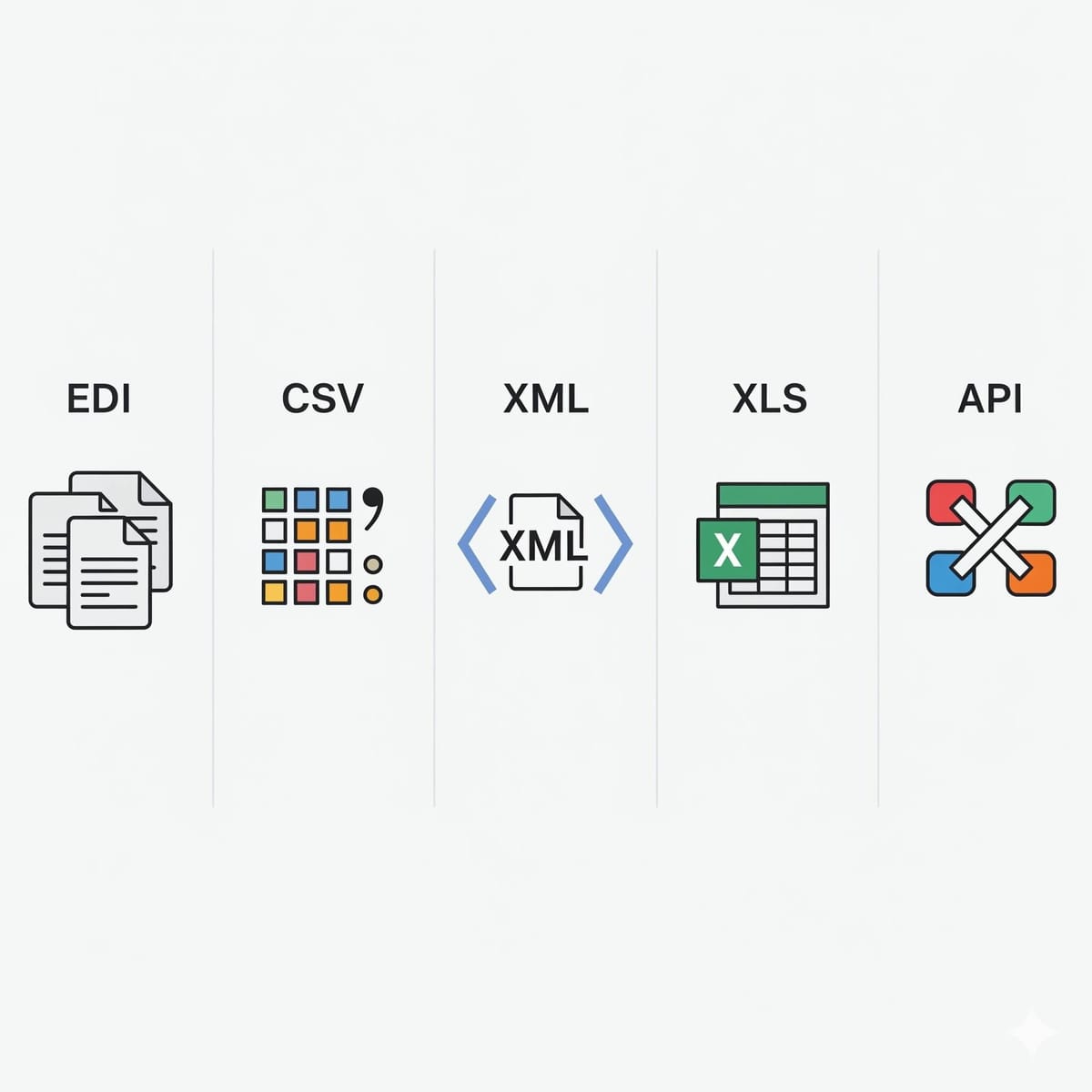
Nexus VAN’s data translation covers all of these formats, providing cross-platform compatibility for routine and complex data flows. If you want more on multi-format integration, see our deep dive on how to simplify data translation across your supply chain.
Any outage in your EDI network (especially a failure of an interconnect) can halt shipments or disrupt your supply chain. Reliable providers publish uptime metrics—Nexus VAN currently operates at 99.998 percent uptime.
Minimizing downtime is not just about technical capabilities; it means protecting your business from lost sales, idle teams, and missed delivery windows.
When EDI traffic crosses jurisdictions, you are expected to follow local compliance requirements on data security, residency, and electronic signatures. At a minimum, insist on:
Your IT and risk management teams will appreciate direct access to audit logs, signed acknowledgments, and up-to-date compliance certifications.
Global EDI introduces new cost drivers, often hidden behind document, mailbox, or interconnect fees. Some VANs also round up document sizes, charging you for more Global EDI introduces hidden cost drivers, including interconnect fees, mailbox charges, and document rounding. Some VANs round up document sizes, meaning you pay for more data than you actually send.
To avoid surprises, ask for:
Nexus VAN uses transparent, usage-based pricing. You are billed only for the kilo-characters you actually transmit, with no rounding, which helps maintain predictable budgets as international volume grows.
Switching a global EDI operation is not a single event. The safest path includes:
For a checklist and more about why staggered migrations are important for international businesses, see our migration risk article. Nexus offers a trial period and a migration dashboard with full visibility over each step—which can help you involve both regional and central teams in the cutover process efficiently.
Once you’re running internationally, support coverage and real-time visibility become critical. Your VAN should offer:

If you are still spending hours chasing support tickets across multiple platforms, or pulling manual reports by region, you may be ready for a more centralized and predictable approach. On that note, you will find more advice in our guide to evaluating EDI support.
Moving beyond US borders brings new document types, higher volumes, and elevated compliance expectations.
Plan for evolving needs by reviewing your contract and exploring whether a platform built for global growth—like Nexus VAN—matches your requirements for scale and control.
You can benchmark your current setup and prepare a changeover plan using a few concrete actions:
One of the biggest hesitations for multinational businesses is migration risk. Nexus VAN is built and staffed by people who’ve navigated large EDI transitions themselves, across brands as varied as Spanx, TIGI, Honda, and Amazon. Instead of a high-risk cutover, you get:
This approach limits risk for both central IT and regional teams, giving everyone the transparency required to feel confident about each step, benchmarked with live data rather than hope or guesswork. If you want more details on what an efficient migration looks like for distributed operations, see our blog on minimizing migration risk.
If you are ready to review your EDI VAN—and especially if you want more predictable costs, clearer visibility, and less stress—the actions above can be done in a single quarter. Benchmark your current footprint, request transparent quotes based on known usage, and run a pilot with a provider who combines comprehensive global interconnects, accurate billing, and risk-free migration. Your bottom line and your operations will thank you.
If you would like to see how Nexus VAN could simplify your worldwide EDI interconnects, visit https://nexusvan.com. You can schedule a short demo or request a usage-based quote using real traffic data. Our EDI specialists can respond to questions and get you started in less than one business day.
