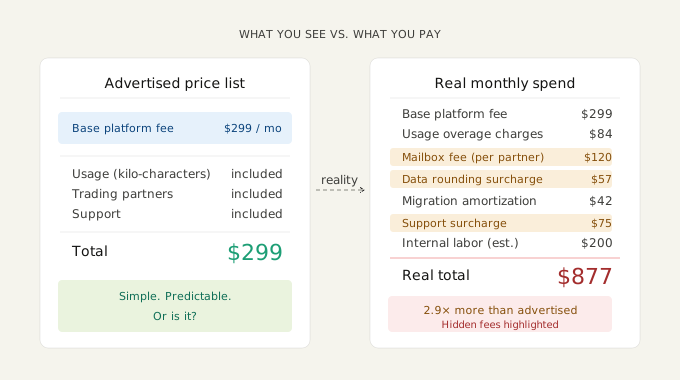

Advertised EDI price lists rarely reflect what you will actually pay. Hidden fees — including mailbox charges, data rounding surcharges, migration costs, and support markups — can push your real monthly spend two to three times higher than the headline rate. To compare providers accurately, you need to evaluate total cost across six components: base fee, usage charges, hidden fees, migration amortization, support overhead, and internal labor.
Many businesses evaluating EDI providers quickly discover that advertised price lists rarely reflect real monthly spend. This disconnect comes from hidden fees, unpredictable surcharges, and inconsistent billing methods across vendors. To truly understand your EDI costs — and avoid budget surprises — you need to evaluate every component that contributes to your total monthly invoice, not just the base subscription rate.
At first glance, comparing EDI value-added networks (VANs) seems straightforward: just look at the price chart. In practice, however, each vendor uses different measures for EDI billing — whether by message, document, transaction, kilobyte, or kilo-character — and most tack on extra fees. These differences make it nearly impossible to judge which provider offers genuine predictability or the best value.
A plan that looks economical on paper might include mailbox fees, onboarding surcharges, or punitive overage rates that push your real costs much higher once your business grows or experiences seasonal peaks. Leading solutions like Nexus VAN are built to eliminate this ambiguity by using transparent, usage-based billing and including the essential services other vendors treat as add-ons.
| Term | What It Means | Why It Matters |
|---|---|---|
| Base Platform Fee | Recurring monthly charge for VAN access and core features | Often the only number shown in advertised pricing |
| Usage Charges | Fees based on data transmission — measured in KC, KB, per message, or per document | Billing unit determines how costs scale with volume |
| Hidden/Admin Fees | Setup, mailbox creation, compliance, onboarding, overages, or partner additions | Rarely disclosed upfront; compound quickly |
| Migration Costs | One-time or amortized charges for transferring partners and data | Can equal several months of base fees |
| Support Costs | Fees or restrictions on technical support and troubleshooting | Premium response times often cost extra |
| Internal Labor | Staff time spent managing EDI or working around vendor shortcomings | Invisible on invoices; often the largest real cost |
To eliminate confusion and compare offers on a level playing field, use this complete formula:
For every EDI provider under consideration, fill in each part of the formula using your actual or forecasted usage and business needs. This approach ensures you see past marketing claims and uncover the genuine costs you will face.
Hidden and indirect fees are common in the EDI industry. The most frequent offenders:
| Fee Type | How It Works | Risk Level |
|---|---|---|
| Mailbox / partner account fees | Charges per trading partner, mailbox, or department | High — compounds with growth |
| Setup and migration charges | Fees for onboarding, data mapping, or technical implementation, quoted separately | High — often a large one-time surprise |
| Support surcharges | Expedited response or complex troubleshooting billed at a premium | Medium — depends on issue frequency |
| Data rounding | Vendors bill a 401-byte document as 2 KB, multiplying charges unnoticed | High — invisible and cumulative |
| Overage and compliance fees | Usage beyond your tier and document validation services | Medium — spikes during seasonal peaks |
Nexus VAN uses kilo-character billing that never rounds up, with flat inclusive tiers covering migration, partner expansion, and responsive support. No surprises, no compounding add-ons.
Gather your EDI document counts, average and peak monthly data volumes (in kilo-characters if possible), and the number of partners and mailboxes in use. This gives you a baseline for all vendor quotes.
Require every provider to present a written quote that clearly itemizes all monthly recurring charges, explicit inclusion or exclusion of migration and mailbox fees, support response times, and the billing unit with rounding policy.
Divide any one-time migration quote by 12 to spread it over your first year for an apples-to-apples monthly comparison. With Nexus VAN, migration and onboarding are included at no extra cost — which meaningfully changes the comparison for most companies.
If your current provider delivers slow or inconsistent support, your internal IT or EDI staff may spend hours chasing down issues. Efficient support and transparent tooling can cut internal resource allocation by more than half, especially during critical go-lives.
Test your cost model using different usage levels and partner counts. What happens to your invoice when you double your partners during a high-growth period, or handle a surge in document volume around the holidays? A pricing model like Nexus VAN's — which includes unlimited IDs, partners, and mailboxes — keeps growth from triggering unexpected fees.
One of the most common sources of wasted EDI spend is billing based on rounded document sizes and arbitrary thresholds. If a provider bills a 401-byte document as 2,000 bytes due to rounding rules, you pay for data you never actually transmit. This is particularly impactful for businesses with a mix of large and small transactions.
Kilo-character pricing, especially without rounding, aligns your invoice to your real activity. Nexus VAN never rounds up document size — your bill reflects only what you transmit.
These questions help expose critical sources of hidden cost and let you compare options with full clarity. For more detailed fee breakdowns, see our post on common EDI VAN fees.
Companies that have migrated to Nexus VAN often do so after being frustrated by complex, opaque invoices and escalating fees. Spanx cut costs and improved operational transparency after switching from a provider that imposed high rates and unpredictable surcharges. TIGI, with a complicated retail supply chain, gained more control and stability by eliminating onboarding fees and integration headaches.
These real-world transitions show that transparent billing models can have an immediate and sustained impact on EDI budgets — especially where growth and supply chain agility are priorities. Details on these and other success stories can be found in our published case studies.
Many organizations hesitate to leave their legacy VAN, fearing disruption, data loss, or trading partner downtime. You can mitigate this risk by selecting a provider with guaranteed migration support, robust dashboards for tracking progress, and proven project management.
At Nexus VAN, migrations are handled with a structured, phased approach and experienced human support, lowering the operational risk to near zero. The portal delivers transparency at every step, from partner mapping to final cutover. This commitment, coupled with the risk-free 90-day trial, significantly simplifies budgeting and validates cost savings without jeopardizing day-to-day operations. For teams planning a transition, our guide on switching EDI providers can help you prepare.
Nexus VAN's transparent, kilo-character billing means no hidden fees, no data rounding, and no surprises. Start with a 90-day risk-free trial.
Schedule Demo View PricingCompare written quotes that itemize every fee: usage, migration, mailbox, partner, support, and overage. Ask how billing units are calculated and whether the vendor rounds up document sizes. If charges are unclear, request clarification in writing before proceeding.
Some vendors use this model to create predictable recurring revenue, but it penalizes your business for normal growth. This structure often surprises customers after the first invoice and makes scaling costly. Providers like Nexus VAN include unlimited IDs and mailboxes to remove these penalties.
Kilo-character pricing means you pay based on the actual number of characters transmitted, not per message or per document. When there is no rounding up, your charges align exactly with what you send, reducing waste and making costs easier to forecast.
Yes — if your provider bills transparently on actual usage, includes migration and partner support, and does not rely on add-on fees. With this approach, you can project expenses with much greater confidence. Regular usage reviews, as discussed in our mid-year EDI cost review blog, are also helpful.
Migration risk can be controlled with careful planning and responsive support. Nexus VAN offers migration management, an intuitive dashboard, and expert staff to ensure you move partners without interruption, backed by a 90-day trial.
Use a cost comparison tool or spreadsheet, plug in your current and forecasted volume, and request complete quotes from each vendor. Look for included services like migration and support. A hands-on trial or pilot can further confirm that the numbers match real service levels. Our post on validating EDI costs with a trial details this approach.
