Cloud EDI vs On-Prem: 3-Year TCO and Hidden Staffing Costs

December 12, 2025
EDI Cloud vs. On-Prem: We expose the hidden staffing and infrastructure costs of managing EDI yourself. Learn how a managed cloud VAN eliminates downtime risk, unpredictable bills, and the 'part-time EDI engineer' trap.
Header image

Choosing how you manage your EDI operations impacts not just your IT budget, but your staffing model, ongoing risk, and the agility of your business. In our years supporting experienced EDI professionals, we’ve seen all the cracks in traditional on-premise EDI, and we know how tough it is to make that first jump to a cloud model. Let’s walk through the real math and operational realities, and uncover costs and risks you might not see until they impact your bottom line.

Understanding Cloud EDI and On-Prem EDI

First, let’s clarify what’s at stake. On-prem EDI means managing everything yourself: servers, EDI translation software, security, upgrades, and 24x7 support. In the cloud (a managed EDI VAN), you access the service online, relying on your provider’s infrastructure, monitoring, and expertise. At Nexus VAN, we shoulder the infrastructure, operational, and compliance burden so you can keep your team focused on growing the business and supporting your partners.

How to Compare 3-Year TCO: The Framework

We recommend analyzing total cost of ownership (TCO) over three years, not just licensing costs or monthly bills. This honest model should include:

  • Staffing: salaries, taxes, training, and overtime
  • Hardware and network: servers, software maintenance, networking gear, power/cooling
  • VAN fees: kilo-character (KC) usage, mailbox fees, per-partner charges, hidden processing fees
  • Hidden costs: unplanned downtime, migrations, upgrades, and project overhead

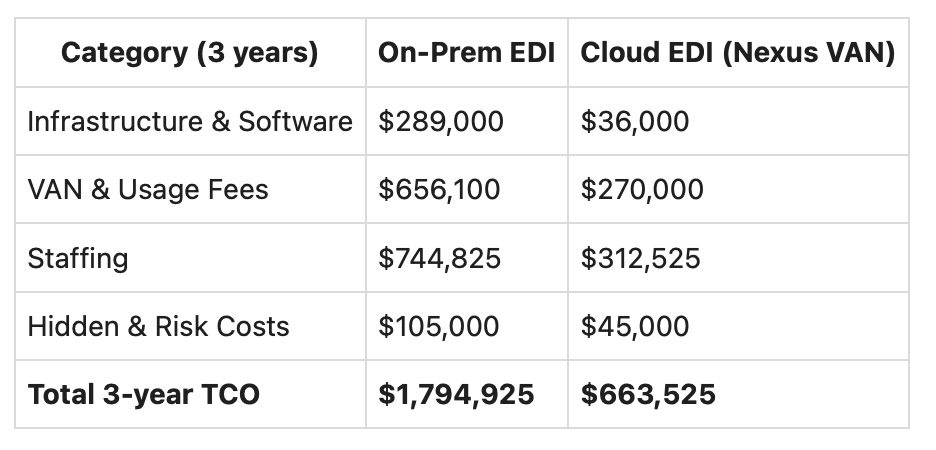
Let’s use a concrete example: A mid-market company handling 60,000 EDI transactions a month, with 40–120 trading partners and 15–40 users. This is a realistic profile for many businesses we work with.

3-Year TCO: On-Prem EDI

Infrastructure and Software

  • EDI licenses and maintenance (3 years): $184,000
  • Hardware, support, networking/security: $105,000
  • Power, cooling, and other allocations: $12,000

Subtotal (3 years): $289,000

VAN and Usage Fees

  • KC usage (legacy VAN, with rounding and extra fees): $648,000
  • Mailboxes and partner fees: $8,100

Subtotal (3 years): $656,100

Staffing Costs

  • EDI specialist(s), admins, security (loaded, incl. overtime): $744,825

Hidden and Risk Costs

  • Downtime, migrations, upgrades: $105,000

Total 3-year TCO (On-Prem): $1,794,925

3-Year TCO: Cloud EDI with Nexus VAN

VAN Subscription (KC-based)

  • Nexus VAN charges by actual kilo-character transmitted, with no mailbox, user, partner, onboarding, or compliance fees
  • Coverage for up to 150,000 KC/month: $7,500/month ($270,000/3 years)

Infrastructure and Software

  • Minimal in-house expense (integration server/iPaaS): $36,000

Staffing

  • Internal EDI staffing and support reduced by up to 58%: $312,525

Hidden and Risk Costs

  • Less downtime and project overhead: $45,000

Total 3-year TCO (Cloud/Nexus VAN): $663,525

That’s a 63% savings by moving to cloud EDI in this example, with most of the gain coming from lower VAN billing, staffing efficiencies, and a dramatic cut in project and downtime exposure.

Hidden Staffing Costs in On-Premise EDI

The headline numbers rarely tell the full story for IT leaders, CFOs, or private equity teams. The staffing model with on-prem EDI produces less obvious, but significant budget leaks:

The "Part-Time EDI Engineer" Trap

  • Key EDI knowledge lives with one or two individuals
  • Absences or attrition leave your business exposed
  • New projects or issues can bottleneck your roadmap as that team juggles priorities

With cloud EDI managed through a platform like Nexus VAN, your people focus on exceptions and relationships rather than infrastructure firefighting.

The Scarcity of EDI Staff

  • When your EDI expert leaves, recruiting and onboarding is costly and slow
  • Skill ramp-up takes months since this is a niche field
  • Every transition introduces risk of errors or SLA failures

A mature managed VAN reduces your dependency on hard-to-find experts, making it possible to staff with broader IT or business analysts supported by the vendor’s experts.

Project Churn

  • On-premise EDI requires regular hardware refreshes, OS migrations, and major application upgrades every few years
  • IT teams spend hundreds of hours coordinating testing, partners, and cutovers

Nexus VAN handles upgrades and scaling transparently, so your “project” is a validation checklist, not a multi-month fire drill.

Why Cloud EDI Isn’t Really More Expensive

The idea that cloud is inherently pricey for steady, business-critical workloads has some truth if you only compare direct server costs. But this view ignores what you’re paying for:

  • Continuous connectivity with all global VANs
  • SOC 2 compliant security
  • Automatic failover, retries, and error handling policy
  • Direct, expert support for onboarding, migration, and compliance

On-premise means cobbling this together with added tools, consultants, and nightly maintenance.

Tackling the Big Objection: The “Risk” of Switching Your EDI VAN

In our experience, perceived risk, not actual migration complexity, stops many organizations from making a change. Nexus VAN is designed from the ground up to remove these roadblocks and put real control in your hands, not ours. Here’s how:

  • 90-day free trial with parallel run capability. You can validate every EDI process before cutover—no guesswork
  • Migration dashboard for real-time progress and risk visibility
  • Playbooks developed by veterans of Fortune 500 migrations. Zero setup or migration fees
  • Transparent, predictable pricing. You pay by the kilo-character you use, not an estimate, and never get a surprise bill

You can read more about how transparent billing models and same-day support drive predictable outcomes in our recent post on billing transparency.

Building Your EDI TCO Case

For CFOs and IT leaders who need a hard number for board or investment review, here’s what works best:

  1. Gather historic invoices for your VAN, EDI staff allocations, and infrastructure costs linked to EDI
  2. Project them three years out with conservative growth estimates
  3. Add a 10–20% contingency for unplanned incidents, downtime, or migrations
  4. Request a quote based on expected monthly KC volume from Nexus VAN. There are never separate fees for migration, onboarding, or compliance

When you line up the real numbers, most organizations save 40–80% compared to old-model VAN billing and heavy internal staffing, even before counting the agility and uptime improvement.

Actionable Steps to Move Forward

  • Request your actual data volume and cost evaluation from Nexus VAN. This usually takes one business day. If you’d rather see numbers in action, our demo process lets you experience our portal and service migration dashboard directly
  • Quantify staffing time saved—often totaling more than $150,000–$250,000 over three years that doesn't show up in a software comparison
  • Ask what a risk-mitigated migration would look like in your environment, and what the cutover plan could be with side-by-side validation

Making Your EDI Operations Predictable and Cost-Effective

Cloud EDI through a provider with real transparency, like Nexus VAN, isn’t just about outsourcing a headache. It’s about transforming a patchwork of hidden fees, support black holes, and brittle legacy servers into a predictable, modern platform, complete with full compliance, cost certainty, and fast support when you need it. The numbers show this isn’t risky, it’s practical.

We’re passionate about helping organizations move from overpaying and firefighting to stable, future-proof EDI operations. If you want to break down your actual 3-year TCO or see how our migration tools work, feel free to connect with our team or try our risk-free trial at Nexus VAN.

Share this post