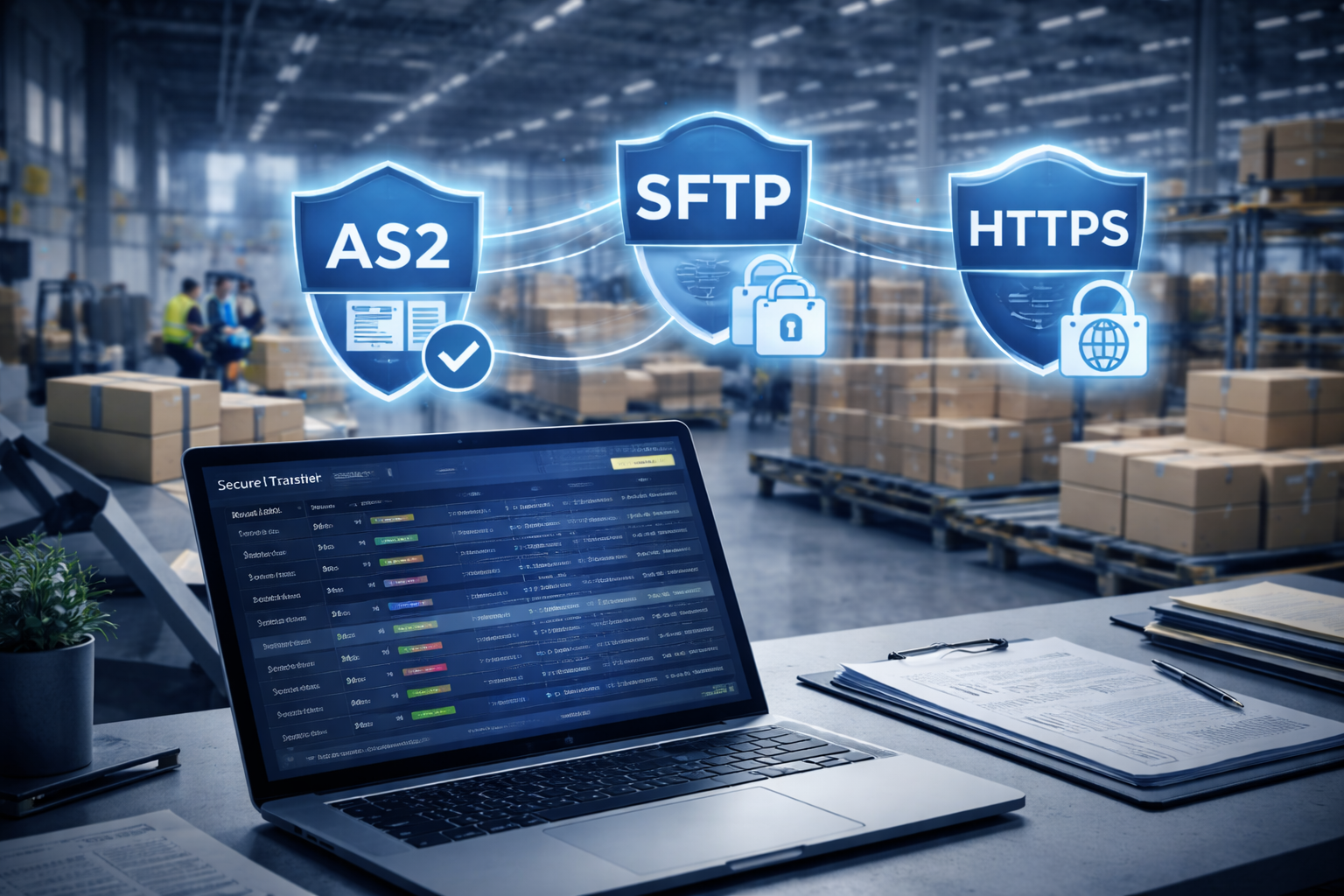

If you manage EDI for your business, the question of which data transfer method to use for each partner is critical. You have options—AS2, SFTP, VAN, API—and each approach fits a different scenario. You want secure, reliable, and efficient connections that support your supply chain, match your partners’ requirements, and do not burden your IT team. The right choice will minimize costs, reduce manual effort, and ensure business continuity.
To decide, start by examining your partner network. If you need to connect with dozens or even hundreds of trading partners that all use different systems, a Value-Added Network (VAN) like Nexus VAN is usually the most practical and scalable foundation. VANs simplify the process by integrating all major protocols, handling compliance, and offering a single connection point that works for everyone. For partners with strict requirements (like major retailers mandating AS2 or those asking for API integration), you can mix and match as needed without extra complexity. Many organizations find a hybrid approach works best—using a VAN for most partners, while layering in AS2, SFTP, or API where those are required or preferred.
A VAN is a managed service provider that sits between you and your trading partners to route, secure, and monitor EDI documents. The VAN handles message delivery, mailbox management, archival, auditing, and protocol compatibility. Services like Nexus VAN offer direct connections with every major VAN, supporting AS2, SFTP, and REST APIs on your behalf. With a VAN, you can connect with hundreds of partners without building or maintaining custom point-to-point links for each one.
You should consider a VAN if you have a mix of partners, want to future-proof your integration, or need to reduce IT workload.
AS2 offers direct, secure point-to-point communication between you and a trading partner. It uses encryption and digital certificates for security and provides non-repudiation by sending confirmation receipts. AS2 is often required by large retailers, manufacturers, and logistics providers, and is valued for its security and directness.
Downsides appear when you need to manage connections for many partners. Certificate renewal, configuration, and troubleshooting increase with each relationship.
SFTP provides secure file exchange by encrypting files in transit. You or your partner host a server, and EDI documents are uploaded or downloaded directly. SFTP is widely used for point-to-point file transfers, especially for partners who rely on older or simpler technology stacks.
Challenges include manual intervention if transfers fail, no built-in monitoring, and increased maintenance when multiple partners are involved.
API-based connections enable real-time data flows between internal systems and partners. APIs can handle EDI-like documents or support direct event-driven integration. This is a modern approach growing in popularity, especially for real-time inventory and order management between business systems.
APIs are a supplement to—not a replacement for—traditional EDI in most supply chains, since few networks are fully API-ready yet.
Most companies benefit from using a VAN as their core EDI infrastructure, layering on AS2, SFTP, or API where absolutely required. This approach saves time, avoids duplicate effort, and limits complexity. Nexus VAN supports all major protocols with a single connection and centralizes your compliance, management, monitoring, and support.
Many organizations hesitate to change their EDI infrastructure due to worries about disruption, hidden fees, or data loss. In reality, if you choose an experienced VAN partner that guarantees successful migration and compatibility, those risks are mitigated. For example, Nexus VAN delivers seamless migrations backed by transparent pricing and a 90-day trial, and most companies moving from legacy VANs to Nexus VAN save 40 to 80 percent while gaining full control and visibility.
If you want more insight into common VAN pitfalls and onboarding issues, read our resource: Why Are EDI VAN Bills So Confusing.
Companies ranging from retail brands to suppliers have improved efficiency and reduced costs by migrating to Nexus VAN. For example, Spanx achieved immediate savings and gained total transparency over their EDI costs after moving away from a VAN provider with hidden surcharges. TIGI, facing a complex retail supply chain, streamlined onboarding and eliminated integration issues through the flexibility of Nexus VAN’s fully managed offering. For a closer look, explore our documented stories at Nexus VAN case studies.
A VAN centralizes and simplifies EDI management. With a provider like Nexus VAN, you can connect to any partner using any protocol, while minimizing manual work and IT risk. The VAN manages routing, compliance, monitoring, and supports migration from your current provider.
Use AS2 for high-volume, direct connections where your trading partner explicitly requires it, or for vendors like major retailers that standardize on AS2. For most other policy, a VAN is simpler and more scalable.
Yes, SFTP encrypts data in transit, but you are responsible for managing server security, credentials, and monitoring. For fewer partners and established IT processes, SFTP is reliable, but a VAN adds central oversight and automation.
Not yet. APIs enable real-time automation, but most trading partners still rely on classic EDI standards. APIs are often used alongside, not instead of, traditional EDI infrastructure.
With an experienced provider like Nexus VAN, migration is low risk. We provide a 90-day free trial, transparent pricing, and a guaranteed, successful setup. Most businesses experience no downtime or business interruption. Learn more about switch strategies in our article: When Is It Time to Switch EDI VAN Providers?
Nexus VAN uses a pricing model based on the exact number of kilo-characters transmitted, without rounding up. There are no setup, migration, mailbox, compliance, or overage fees.
When choosing between AS2, SFTP, VAN, and API, your best route is to stay flexible. Reliable EDI infrastructure should not lock you into high costs or technical headaches. If you are ready to consolidate, modernize, or clarify your EDI program, consider learning more about Nexus VAN's approach and how we support risk-free migration, transparent pricing, and expert live support.
